
From Nurdles to Natural Remedies: A Day of Confronting Plastic — and Reimagining Self-Care

During one of our recent retreats at Mahai, we took our guests to visit the Sandy Turtle Sanctuary, a coastal conservation project run by Menos Plásticos es Fantástico.
What we experienced there was both eye-opening and deeply sobering.
The Invisible Plastic Problem
The team at the sanctuary began by teaching us about nurdles — tiny plastic pellets that serve as the raw material for most plastic products manufactured around the world.
These pellets are small — about the size of lentils — but they represent one of the largest sources of microplastic pollution in the ocean.
Billions of them are produced every year, transported across the globe, and far too often spilled or lost during shipping and manufacturing. Once they reach the ocean, they are nearly impossible to remove.
After the presentation, we joined their citizen-science effort: nurdle hunting.
With careful eyes, we combed through the sand searching for the tiny pellets so they could be counted and reported for environmental monitoring. Each one felt insignificant in our hands — yet together they told a massive story.
Walking the Plastic Coastline
After the nurdle search, we walked along a nearby stretch of coastline.
It was difficult to see.
Bottle caps. Broken toys. Fragments of containers. Tangled fishing lines. Endless pieces of plastic that had been carried across oceans before arriving here.
Plastic has reached nearly every corner of our planet — from remote beaches to the deepest parts of the sea, and even into the air we breathe and the water we drink.
Standing there together, many of us felt a mix of sadness, frustration, and helplessness.
The scale of the problem is overwhelming.
Turning Awareness into Action
Before leaving the sanctuary, we did something simple but meaningful: we created hand-painted signs for the local community encouraging people to reduce plastic use and care for the coastline.
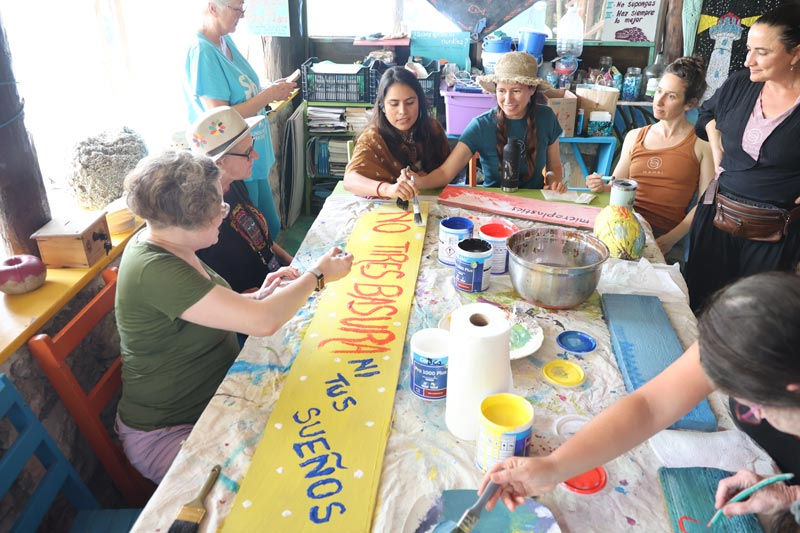
They weren’t fancy. Just wood, paint, and messages from the heart.
But they were a reminder that awareness must lead to action.
Even small acts of care matter.
Still, the emotional weight of the day lingered with many of us.
A Different Kind of Workshop
The very next day at Mahai, we had another workshop — this time with herbalist Gabriela Alcántara, who led us through her Wild Apothecary Workshop.
Instead of focusing on what is wrong with the world, this workshop focused on what is still possible.

Using simple natural ingredients — coffee, honey, herbs, oils, flowers, and pantry staples — she taught us how to make:
body scrubs
face scrubs
nourishing hair masks
natural skin treatments
As we mixed ingredients together, something shifted.
The conversation moved from “Look how damaged the world is”to “Look what we can create ourselves.”
The Power of Consuming Less
One of the most powerful realizations from the workshop was how many everyday products we don’t actually need to buy.
Many personal care items — scrubs, masks, treatments — can be made easily at home using ingredients that are:
healthier for the body
free from synthetic chemicals
and completely plastic-free
It was a small but profound reminder that reducing our impact doesn’t have to feel like deprivation.
It can actually feel like reconnection — with the earth, with traditional knowledge, and with our own creativity.
From Grief to Possibility
The visit to the turtle sanctuary showed us the consequences of a disposable culture.
Gabriela's workshop showed us an alternative.
Together they formed a powerful arc:
Awareness → grief → responsibility → possibility.
At Mahai, we believe experiences like these are part of the deeper purpose of retreat.
Not just relaxation. Not just wellness.
But moments that help us see the world more clearly — and imagine how we might live differently within it.

--------
Click here to learn more about and support our project to remove plastic from the ocean and beaches.


Comments